

Hand Safety in Oil and Gas: Four Hazards, One Pair of Hands
By | October 6th, 2026
October 6th, 2026
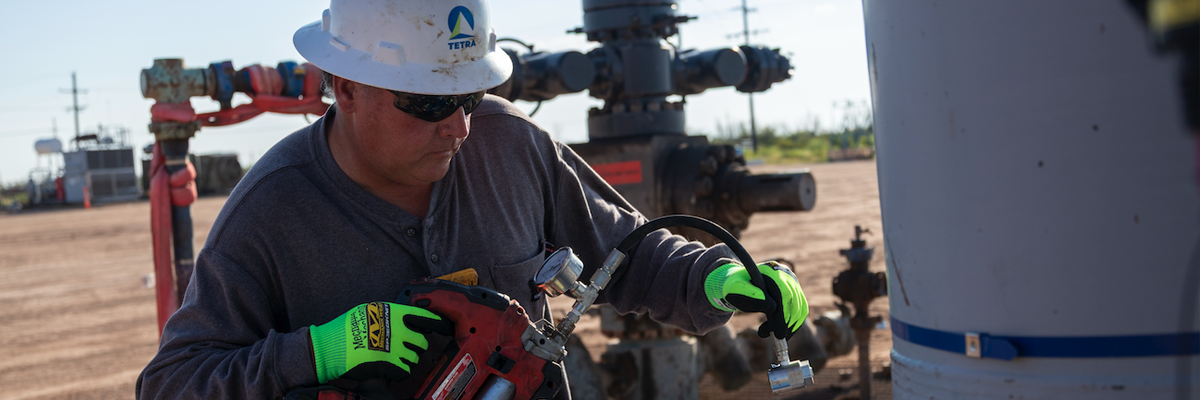

Many jobs on an energy services site involve the use of our hands. That is why hand injuries rank among the most common incidents across industrial and energy work sites — and among the most preventable.
Preventing them comes down to three things: knowing which hazards you are working with, matching the glove to the task, and building three habits that take no extra time.
Roy McNiven, Senior Vice President of Energy Services, and David Domingue, Director of HSEQ, cover the four hazard types and three habits in 90 seconds.
Hand Safety: Small Habit, Big Difference — Roy McNiven and David Domingue on the four hand hazards and the three habits that take zero extra time. Runtime 1:30.
Most hand injuries happen during routine work
These are not freak accidents. They happen during tasks crews have done a hundred times — loading a hose, changing a filter, racking pipe.
By the tenth repetition, hands move on autopilot. That is when a pinch point can catch somebody off guard. Staying deliberate on routine work is the control.
Four hazards, four different ways to get hurt
Hand injuries fall into four categories, and each one fails differently.
- Pinch points and crush hazards. Anywhere two objects come together — gears, rollers, closing doors, pipe connections.
- Lacerations and punctures. Sharp edges, blades, exposed metal burrs, even packaging. Cuts are the single most common hand injury.
- Chemical exposure. Brines, caustics, and acids that can damage the skin.
- Thermal hazards. Hot surfaces, steam, and friction from rope or cable running through the hands.
Same hands, four completely different exposures. One glove does not cover them all.
Match the glove to the task
Cut-resistant gloves handle sharp materials and blade work, but do little against a chemical exposure. Chemical-resistant gloves — nitrile, neoprene, butyl — must be rated for the specific product in use, because chemical resistant is not one-size-fits-all. Insulated gloves cover hot work and cold exposure. Impact gloves with reinforced backs belong around pinch points and heavy equipment.
Check the safety data sheet before handling an unfamiliar product. Inspect gloves before every use. Torn, thinned, or chemically degraded gloves give a false sense of protection and should not be used.
Know when to take gloves off. Rotating equipment can catch a glove and pull a hand in with it. Sometimes the safest move is bare hands and extra distance.
Three habits that prevent hand injuries
1. Keep hands out of the line of fire. Before pulling, pushing, or pinning something, ask where will your hands end up if it shifts or releases. Reposition before you act.
2. Use the tool, not your fingers. A pry bar, push stick, or other tools exists to keep hands out of pinch points.
3. Slow down on the last step. Most hand injuries occur at the very end of a task — final tightening, final release, final disconnect.
The job is not done until your hands are clear.
See a hand hazard? Report it.
A missing guard, a degraded glove, a pinch point without a warning — report it. That is how the fix happens before the incident does.
Frequently Asked Questions
Routine tasks, not unusual ones. Most hand injuries happen during work crews have done many times — loading a hose, changing a filter, racking pipe — when hands start moving on autopilot.
Pinch points and crush hazards, lacerations and punctures, chemical exposure, and thermal hazards. Each fails differently, so one glove type cannot protect against all four.
Around rotating equipment. A glove can be caught and pull a hand in with it. In those cases the safer control is bare hands and extra distance.
