

Brady Murphy at PWS 2026: Produced Water’s Data Center Moment
By | August 26th, 2026
August 26th, 2026

At the 2026 Produced Water Society Conference in Midland, TX, TETRA President and CEO Brady Murphy delivered a keynote with a clear message: produced water desalination has moved from promising technology to commercial necessity. Eighteen months after his last PWS address, Mr. Murphy told attendees, “what feels like an industry crisis is closer and more urgent to solve.”
The Numbers Behind the Urgency
The Permian Basin now produces roughly 21 million barrels of produced water per day — a 5:1 water-to-oil ratio. Disposal capacity isn’t keeping pace: rising formation pressures, tightening SWD permitting, and long-haul disposal costs up 3-4x in a decade are converging fast. Mr. Murphy cited B3 Insight data projecting produced water volumes could exceed 28 million barrels per day by 2036, with recycle-for-frac demand alone rising from 64% to 95% of total frac water need.
Data Centers Change the Equation
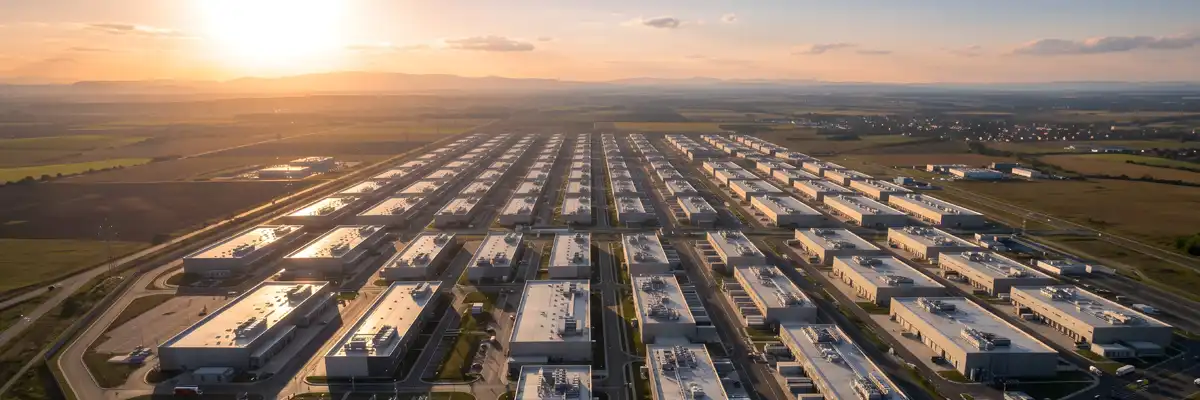
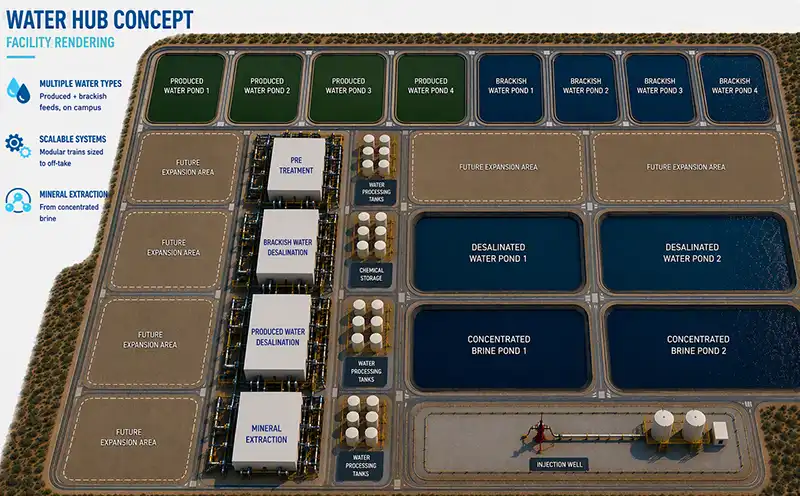
The new variable, Mr. Murphy explained, is the wave of AI and hyperscale data centers moving into Texas. A single 1-gigawatt data center can consume up to 220,000 barrels of water per day — volumes fresh water supplies in West Texas simply can’t absorb without straining local communities. That demand, paired with an oversupply of produced water, is accelerating what TETRA calls a “Water Hub” model: treating brackish and produced water at commercial scale for beneficial reuse.
Inside TETRA Oasis TDS
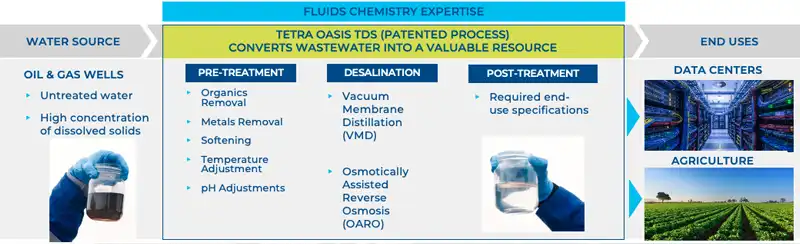
TETRA meets this challenge with the patented TETRA Oasis Total Desalination Solution (TDS), which pairs OARO membrane technology with vacuum membrane distillation for high-efficiency, cost-effective recovery. Mr. Murphy reported TETRA Oasis TDS can produce water quality that is better, and in some cases much better, that of local aquifers, and that economics improve significantly at scale — from an initial 25,000 barrel-per-day design to a 100,000 barrel-per-day plant now in engineering.
Mr. Murphy also highlighted mineral extraction as a built-in upside. At Permian volumes, he noted, iodine recovery alone could reach roughly three times current global production.
A Win-Win-Win
Mr. Murphy closed by framing produced water desalination as a rare alignment of interests: supplying data centers and power generators with reliable water, recovering valuable minerals, and reducing disposal strain on the Permian Basin — all at once. “Converting today’s waste into a resource of clean, usable water,” he said, “is an incredible opportunity.”
Play the video below to listen to Mr. Murphy’s keynote presentation at the Produced Water Society 2026 Conference.
This post contains forward-looking statements regarding TETRA Oasis, desalination project economics, and potential mineral extraction. These are not guarantees of future performance and are subject to risks and uncertainties described in TETRA’s SEC filings, available at onetetra.com/investors. Mineral figures referenced are illustrative and do not have demonstrated economic value. TETRA undertakes no obligation to update these statements except as required by law.
